

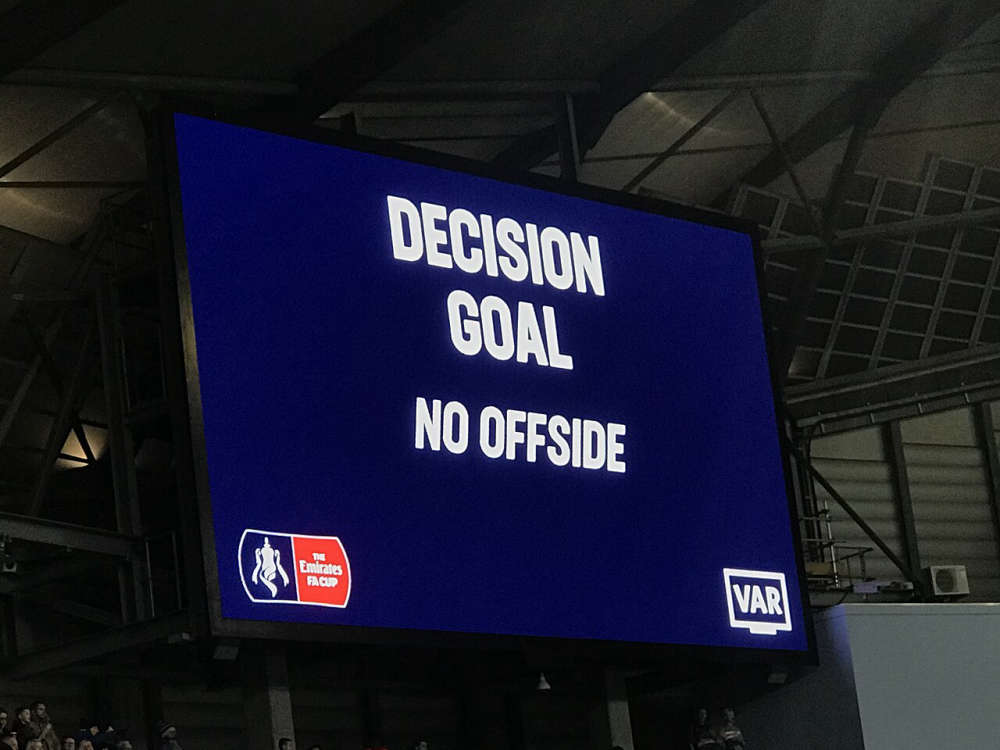
VAR has been nothing short of controversial since its introduction in 2018 and it is about to undergo even more changes from this year’s World Cup and onwards.
The changes confirmed by the International Football Association Board (IFAB) include corners and second yellow cards being added to what the video assistant referees (VAR) can help the on-field referee with.
Other changes aside from VAR are time limits on throw-ins, goal kicks and substitutions.
Rules regarding player injuries have also changed.
Corners and second yellow cards
IFAB have confirmed that the AGM approved that red cards arising from a clearly incorrect second yellow card will be allowed to be checked by VAR.
VAR will also be able to review mistaken identity, when the referee penalises the wrong team for an offence, causing a red or yellow card to be shown to the wrong player.
Incorrectly corner kicks will also be checked and reviewed starting from the World Cup.
VAR in operation. Credit: Wikipedia Commons.
Do we need more VAR?
People are already complaining that VAR delays the game too much and ruins the flow of football matches, for example the 8-minute offside review in the Atletico Madrid vs Barcelona match a few weeks ago. Having even more VAR reviews means that the game would be delayed even more. Something that is trying to be eradicated from the game in the rule changes we will look at later in this piece.
But are the delays worth it if we get more decisions correct?
Goal kicks and throw-ins
This season, football has seen a massive rise in long throws and as a result, the time taken to take throw-ins has increased. IFAB confirmed ‘If the referee considers that a throw-in or goal kick is taking too long or being deliberately delayed, a five-second visual countdown will be initiated.’ Delayed throw-ins will be given to the other team whilst goal kicks will result in a corner for the opposition. This is similar to the 8-second rule in play when the goalkeeper has the ball in their hands.
Substitutions
Another new rule introduced states that substituted players must leave the field within 10 seconds of the board being displayed, or their replacement will not be allowed to join the field of play until the first stopping after one minute of play, meaning they would be playing with ten men for that period of time.
This is similar to when an injured player received on-field assessment from medical staff, they must leave the pitch for one minute, rather than the 30 seconds currently in action. Though exceptions include goalkeeper injuries and injuries caused by fouls that result in a card being shown.
Are these changes good for football?
We will not entirely know until they are applied in game is the easy answer, but everyone will have different opinions.
One of these opinions is that these rules are necessary as the game has become slow and boring with timewasting and gamesmanship.
We have seen games disrupted for ‘injuries’, commonly when players go down holding their head, meaning the ref has to stop play- a handy tactic to kill an oppositions momentum. If injured players have to go off for one minute, then could we then see a rise in goalkeepers going down ‘injured’ as the goalkeepers cannot be taken off for one minute?
Something else we have seen grow this season is longer throw-ins, which take a lot longer to do.
The Daily Mail reported that the average Premier League match loses 10 minutes and 43 seconds to delays before throw-ins this season (the figures recorded prior to this weekend’s fixtures). Some would argue that with ticket prices increasing, they are expecting higher quality and more football.
Or are the rules messing with team’s tactical ideas?
The contrary to the rules being good for football, others would argue that long throws are a genuine tactical approach, as seen by Brentford with Michael Kayode.
The long throw-ins were allowed when Rory Delap was doing it with Stoke all those years ago, so why are they being eradicated from the game now?
And let us not forget the inconsistencies that may come from the officials with how long is ‘too long’ for a throw or goal kick, with no specific figure of time given in the laws of the game.
Below are a couple of reactions to the changes.
Don't mind these changes, think the 8 second rule has worked very well this season. Problem is the biggest time waster right now is VAR and they're getting it even more involved next season
— ronnie (@_ronniethompson) February 28, 2026
It’s just a nightmare. More unnecessary stupid changes. Just go back to how it was before VAR and enforce the rules.
— David Lee (@DaveLee101) February 28, 2026
The rules will come into place from the 1st June 2026 ahead of the upcoming World Cup in America, Canada and Mexico in an aim to improve match flow and player behaviour.
Comments
Add a comment